How AI Is Changing the Role of the Ecommerce Merchandiser
September 22, 2026 • Di Lyngholm
TL;DR
- The traditional ecommerce merchandiser spent the majority of their time on manual rules, static overrides, and batch-updated rankings that were already stale by the time they went live.
- AI doesn't eliminate that work - it automates the reactive parts of it, freeing merchandisers to focus on strategy, campaign priorities, and business logic.
- The risk isn't AI replacing the merchandiser. It's black-box AI that removes merchandiser control entirely - and costs you the institutional knowledge that makes those decisions good.
- In production: Brunt Workwear +6.5% RPV and +80% upsell click-through with full merchandiser control intact. Fun.com +142.5% rec revenue with 56% of orders influenced by the intelligence layer.
The ecommerce merchandiser role is being reshaped by AI, but not in the way most headlines suggest. The story isn't about replacement. It's about what happens when the most time-consuming, reactive parts of merchandising get automated, and what that frees the merchandiser to do instead. For years, the job has been defined by manual rules, static rankings, and overnight batch updates that left merchandising teams perpetually behind.
Real-time AI, merchandising control surfaces, and in-session personalization are changing that equation. Search relevance is no longer just a catalog problem, it's a strategy problem. Ranking latency that once forced overnight cycles now resolves in milliseconds. And merchandising control, properly built, means the human stays in the seat while the model does the heavy lifting.
What Did the Traditional Ecommerce Merchandiser Role Actually Look Like?
The traditional ecommerce merchandiser spent most of their time on reactive, manual work: writing product ranking rules, managing category page overrides, suppressing out-of-stock items, and trying to respond to sales trends with tools that updated overnight. The job was less about strategy and more about keeping the storefront from actively working against the business.
That's not a criticism of the people who held those roles. It's a description of what the tooling required.
In a batch-trained, rule-based merchandising environment, the merchandiser is always operating on yesterday's data. Rankings update overnight. Trend signals arrive in reporting dashboards hours after the session that generated them. A product that started selling out at 2pm doesn't get suppressed from search results until the next morning's model refresh - if someone catches it and writes the override manually.
The workflow looked something like this: review overnight reports, identify what changed, write new rules to respond, push those rules live, and wait until the next reporting cycle to see if they worked.
This created a specific kind of merchandiser - skilled at navigating clunky rule interfaces, experienced at predicting what the batch model would do wrong, and practiced at patching gaps between what the system surfaced and what the business actually needed. Valuable skills. But skills developed in response to tooling limitations, not business strategy.
How Is AI Changing What Ecommerce Merchandisers Do Day to Day?
AI changes the merchandiser's day-to-day by automating the reactive layer of the job - real-time ranking adjustments, in-session personalization, inventory-aware suppression - and shifting the merchandiser's focus toward strategy, business priority-setting, and campaign logic. The model handles the moment-to-moment. The merchandiser handles the decisions that require business context the model doesn't have.
This is a meaningful shift, and it's worth being specific about what it means in practice.
The reactive work (what products rank where, which SKUs get suppressed, how results shift as inventory changes) can now happen continuously and automatically. A real-time intelligence layer reads in-session signals as they arrive and adjusts rankings without waiting for a human to review overnight data and write a new rule. The merchandiser doesn't need to catch the sell-out at 2pm. The model already knows.
What that frees up is time and cognitive bandwidth for the work that actually requires human judgment:
- Campaign prioritization: Which product launch gets pinned at the top of search results this week, and for which traffic segments?
- Business logic overrides: When the model's personalization recommendation conflicts with a margin priority or brand direction, who decides - and how?
- Strategy simulation: Before a major sale or seasonal push, what does the personalization strategy look like, and how does it interact with the promotional calendar?
- Cross-functional alignment: How does search and merchandising strategy connect to what the acquisition team is spending on, and what the brand team is saying?
None of this work disappeared. It got promoted. The merchandiser who used to spend so much of their time writing rules now has capacity to spend that time on decisions that move the business.
What Happens When AI Takes the Merchandiser Out of the Loop?
When AI removes the merchandiser from the loop entirely, two things happen: the model optimizes for signals it can measure (clicks, conversions) at the expense of signals it can't (brand direction, margin priorities, campaign context), and the institutional knowledge that made merchandising decisions good gets lost. Black-box AI wins individual optimizations and loses the broader strategy.
This is the failure mode that matters most - and the one most brands don't anticipate until they're already in it.
A fully autonomous model will surface what converts. That sounds like the goal, until you realize that what converts in the short term and what's right for the business in the long term aren't always the same thing. A model optimizing for click-through will surface the products with the strongest historical performance - which means new launches stay buried, margin-unfriendly bestsellers keep dominating, and brand positioning takes a back seat to raw conversion signals.
The merchandiser is the person who holds the context the model doesn't have. They know that the new product line needs visibility even before it has conversion data. They know that the highest-converting SKU in search is also the one that generates the most returns. They know that the brand's seasonal campaign requires specific products to be foregrounded, regardless of what the model would choose on its own.
Removing that person from the loop doesn't just create a control problem. It creates a strategy problem. And it's why black-box AI loses enterprise deals - not because it doesn't perform, but because no serious merchandising team is willing to hand over control to a system they can't audit, override, or align with business priorities.
How Should Ecommerce Merchandisers Think About Working Alongside AI?
Ecommerce merchandisers should think of AI as infrastructure that handles the reactive layer of the job - real-time ranking, in-session personalization, inventory-aware suppression - while they retain control over the strategic layer: campaign priorities, business logic overrides, and the decisions that require context the model doesn't carry. The right AI amplifies merchandiser judgment rather than replacing it.
The practical framing: the model is responsible for the decisions that happen at millisecond speed. The merchandiser is responsible for the decisions that require business judgment.
A well-built AI merchandising layer gives the human several specific capabilities that batch-trained systems never could:
Simulate before going live. Instead of writing a rule, pushing it live, and waiting overnight to see what happened, a merchandiser can test a strategy in a sandboxed environment and see how it interacts with live traffic patterns before committing to it. The cost of a wrong decision drops significantly.
Set personalization intensity by surface. Not every surface should be fully AI-driven. A homepage carousel might warrant full personalization. A brand campaign landing page might warrant more manual control. The merchandiser decides the blend, not the model.
Override the model with context it doesn't have. A new product launch. A clearance push. A partnership placement. The model learns from those overrides - it doesn't fight them. Over time, the model gets better because the merchandiser is teaching it, not just working around it.
Respond to live signals without waiting for a reporting cycle. If something is trending at 11am on a Tuesday, the merchandiser can act on it immediately - and the model is already adjusting in real time underneath whatever manual decision gets made on top.
This is the version of AI-assisted merchandising that actually works in production. Not a replacement. Not a black box. A system the merchandiser can direct, override, and align with strategy - while it handles the execution layer they never had time for anyway.
What Does AI-Assisted Merchandising Look Like in Production?
In production, AI-assisted merchandising looks like a control surface where business users set strategic priorities and the model executes them continuously, in real time, across every customer-facing surface. Merchandisers retain full override capability. The model learns from those overrides. And every surface - search, recommendations, category pages - reads from the same user vector, so decisions made on one surface immediately inform the others.
The results from brands running this model are specific and measurable.
Brunt Workwear ran a Q4 2025 pilot with Malachyte's intelligence layer and full merchandiser control surface active throughout. The outcome: +6.5% RPV and +80% upsell click-through. The merchandiser didn't step back during the pilot. They used the control surface to set campaign priorities, simulate strategies before launch, and override the model where brand direction required it. The AI handled real-time execution. The merchandiser handled strategy. Both worked better for the separation.
Fun.com, live with Malachyte since August 2025, has seen rec revenue up +142.5% year over year and RPV up +31%, with 56% of orders influenced by the intelligence layer. That level of influence across a large catalog requires search, recommendations, and category pages all reading from the same model - so that a signal sent on one surface informs the others immediately. Merchandising decisions made at the top of the stack propagate across every surface automatically.
Jordan Craig saw +17% new-visitor RPV in a head-to-head A/B test against their incumbent stack. New visitors - the group with no behavioral history and no purchase data - converted at significantly higher rates when the model could read in-session signals and personalize from click one. The merchandiser's campaign priorities shaped which products those visitors saw. The model ensured they were the right ones for each individual session.
None of these brands lost merchandiser control when they deployed the intelligence layer. They got more control - over a system that was finally fast enough to act on the strategies they were setting.
The Bottom Line
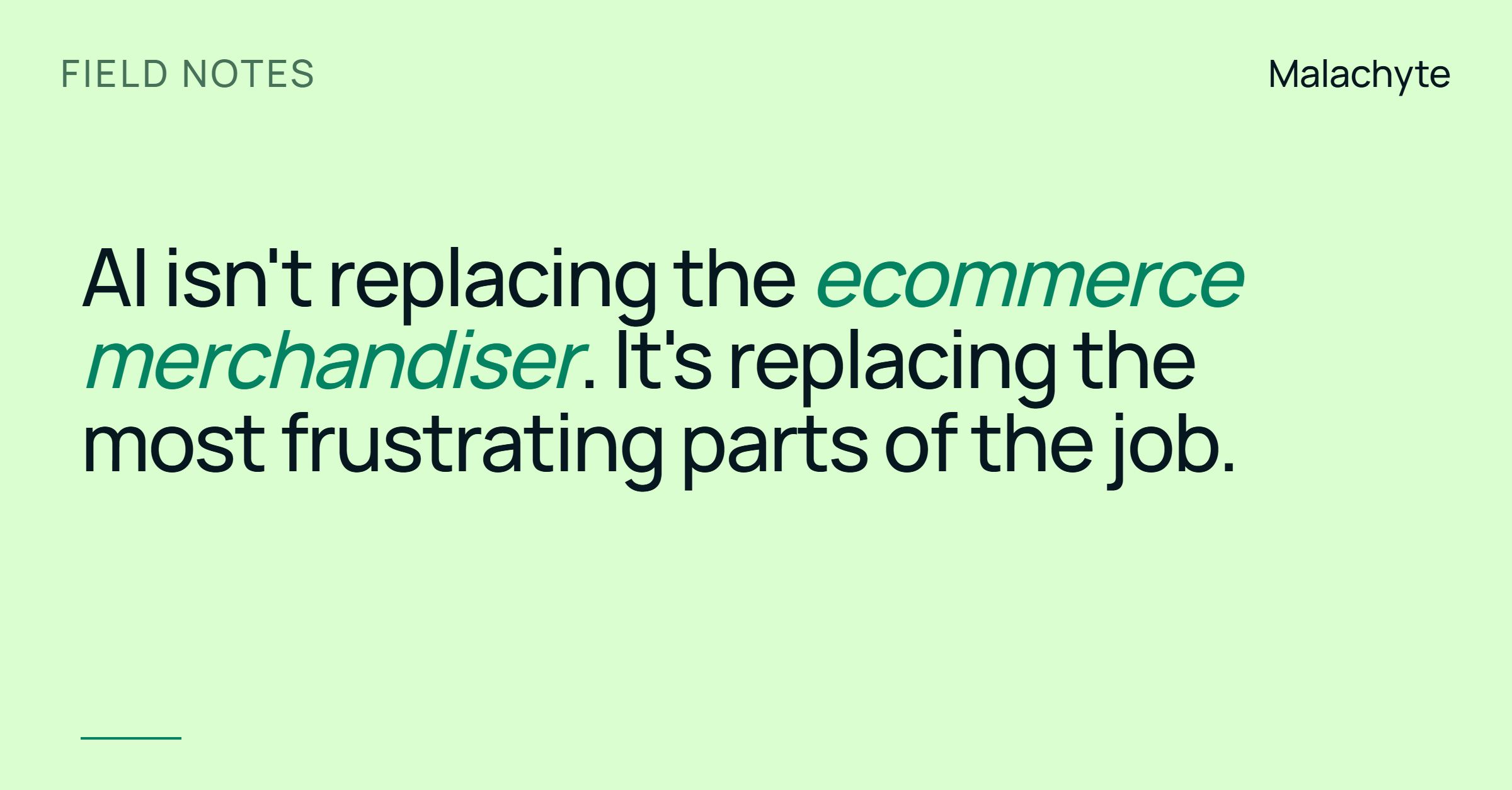
AI isn't replacing the ecommerce merchandiser. It's replacing the most frustrating parts of the job: the manual rule-writing, the overnight batch cycles, the perpetual lag between what the business needs and what the system can execute.
What remains - strategy, campaign logic, business priority-setting, brand alignment - is more important than ever. And it's work that requires a human. A model optimizing for conversion signals alone will make decisions that are locally correct and strategically wrong. The merchandiser is the person who knows the difference.
The brands getting this right aren't the ones that handed off merchandising to a black box. They're the ones that gave their merchandising teams better infrastructure - tools fast enough to execute on strategy in real time, with enough control to ensure the model stays aligned with what the business actually needs.
That's what the intelligence layer is built to do. And it's exactly the gap Malachyte is closing.
Your merchandising team shouldn't be writing rules to patch a slow model. See how Malachyte gives ecommerce merchandisers real-time control over a system that executes their strategy at the speed of the session.